Creative Powdered Donut Mouse Pad Ideas for Your Desk
A mouse pad might seem like a minor desk accessory, but it’s one of the first things people notice when they walk into your workspace. It sits under your hand, frames your keyboard, and sets the visual tone for everything else. A Mouse Pad Powdered Donut design does something unexpected: it combines the familiar comfort of a classic bakery treat with a functional tool you use every day. Whether you are printing these yourself or ordering from a sublimation vendor, the concept opens up a range of creative directions that go far beyond a simple graphic slapped on a surface.
The idea is straightforward. You take a blank sublimation mouse pad, print a design that resembles a powdered donut—often complete with a dusting of white “sugar,” a warm golden ring, and maybe a bite taken out of it—and transfer it onto the pad. What you get is a playful, tactile object that brings a little warmth and humor to an otherwise utilitarian item. But the real value lies in how you approach the design, who you make it for, and where you place it.
Why a Powdered Donut Design Works on a Mouse Pad
On the surface, a donut design is a novelty. But novelty has a function. When you spend hours at a desk, small visual pleasures reduce mental fatigue. A Mouse Pad Powdered Donut graphic gives you a brief, pleasant mental break every time you glance down. It also communicates personality. If you’re a freelancer or small business owner, your workspace is part of your brand. A playful mouse pad tells clients that you don’t take yourself too seriously, while still caring about the details.
From a sublimation standpoint, the powdered donut motif is also technically smart. The white powdered areas allow for soft gradients and subtle highlights. The golden-brown ring gives you room to play with warm tones, shadows, and texture. The bite mark adds a natural focal point that draws the eye. Unlike abstract geometric patterns or busy landscapes, the donut design relies on a recognizable shape with clear contrast. It reads instantly, even at a distance.
Creative Directions for Your Sublimation Mouse Pad
The beauty of sublimation is that you are not limited to a single photographic image. You can interpret the powdered donut concept in many visual styles, each suited to a different audience or purpose. Here are several approaches that have real traction with creators and designers.
Hyper-Realistic Bakery Style
This is the most direct interpretation. Use a high-resolution photograph of an actual powdered donut on a subtle background, such as a kraft paper napkin or a light wooden table. The goal is photorealism. The donut should look good enough to eat, with visible powdered sugar particles, soft crumb texture, and warm lighting. This style appeals to food bloggers, bakery owners, or anyone running a food-related account because it aligns with their visual brand. It also works well for a gaming room if you lean into a cozy, café-inspired aesthetic. Pair it with warm LED lighting and a wooden desk for a cohesive look.
Vector Illustration with Flat Colors
For a more modern or minimalist workspace, consider a vector-style donut. Use clean lines, flat colors, and a simplified shape. The powdered sugar can be represented by small, evenly spaced dots or a soft white overlay with no texture. This approach is ideal for designers who want a clean, professional look without the visual noise of a photograph. It also reproduces consistently across different mouse pad sizes. You can create a full series of donut variations in different pastel tones—strawberry pink, matcha green, or chocolate brown—while keeping the same basic silhouette.
Pop Art and Retro Diner Aesthetic
If you want something bolder, lean into a retro diner theme. Use thick outlines, halftone patterns, and bright colors. The powdered donut can be rendered in a Pop Art style with a dotted background reminiscent of Roy Lichtenstein. This works especially well for a gaming room because it matches the high-energy, graphic-heavy look many gamers prefer. Add a speech bubble or a bold caption like “Fresh Batch” for extra personality. Sublimation handles these solid blocks of color well, and the result is a mouse pad that feels like a collectible item rather than an accessory.
Watercolor or Soft Wash Technique
Watercolor-style designs are popular among creators who sell on platforms like Etsy or at craft fairs. For a powdered donut, a soft watercolor wash creates a dreamy, hand-painted feel. Use pale beige for the donut base, a soft brown wash for the edge, and speckled white for the powdered sugar. This style pairs nicely with a minimalist, Scandinavian-style desk setup. It appeals to audiences who value handmade, artistic touches. It also works well for gift items because the soft aesthetic feels personal and warm.
Adapting the Design for Different Users and Contexts
A Mouse Pad Powdered Donut is not a one-size-fits-all product. Different users will interact with it in different ways, and the design should reflect that. Here is how you can tailor the concept for specific audiences.
For Gamers and Streamers
Gamers tend to prefer larger mouse pads that cover most of the desk. They also appreciate high-contrast visuals that stand out on camera. If you are designing for this group, make the donut large and centered, with a dark background that makes the white powdered sugar pop. Consider adding a subtle glow effect or a neon accent line around the donut to tie it into the RGB lighting many gamers use. A bite mark with a jagged edge adds a slightly edgy feel that fits gaming culture better than a pristine, perfect donut would.
For Remote Workers and Freelancers
If the user is a remote professional who joins video calls regularly, the mouse pad becomes part of their on-screen background. A subtle, muted donut design in soft pastels or monochrome works best here. The goal is to add personality without distracting. Avoid high-gloss finishes or overly bright colors because they can catch light and cause glare on camera. A matte sublimation finish with a low-saturation donut design keeps the desk looking polished while still offering a moment of visual comfort during long work sessions.
For Small Business Owners and Shop Creators
If you are selling these mouse pads, think about packaging and bundling. A single donut design can become a series: plain powdered, chocolate glazed, strawberry iced. Sell them as a set of three for a desk refresh bundle. You can also create coordinating coasters or desk pads with matching donut motifs. This increases average order value and gives customers a reason to buy more than one. When photographing your products, stage them with real donuts or warm coffee cups to reinforce the bakery theme. This builds a stronger emotional connection with buyers.
Practical Tips for Clear and Effective Results
Sublimation on a mouse pad requires attention to detail, especially with a design that has white areas. Here are a few guidelines that keep your final product looking sharp and professional.
- Use a pure white base for the powdered sugar areas. Because sublimation does not print white, the white fabric of the mouse pad must serve as the powdered sugar. Make sure your design leaves those areas completely blank or uses a very light tint that the white fabric can show through.
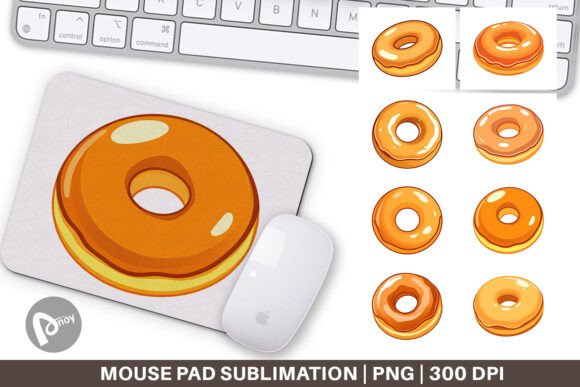
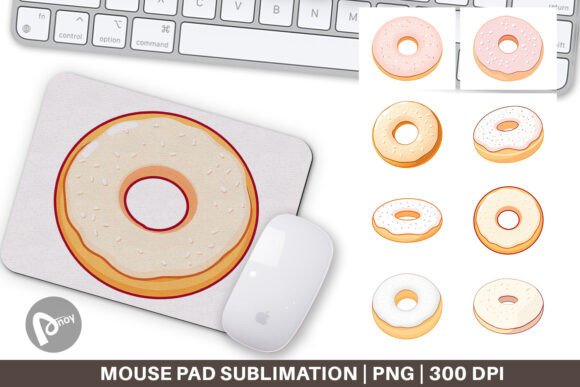
- Keep the resolution above 300 dpi. The file you mentioned—8 PNG files at 9.5 x 8.1 inches at 300 dpi—is exactly what you need for a crisp transfer. Anything lower will look soft or pixelated, especially on the curved edges of a donut.
- Pay attention to the heat press time and temperature. Mouse pads often have a rubber base that can warp if over-pressed. Follow your sublimation paper and blank manufacturer guidelines. Typically, 385–400°F for 45–60 seconds with medium pressure works, but always test a sample first.
- Consider the edge of the mouse pad. A full-bleed design looks best if the donut extends to the edges, creating a seamless look. If your blank has a stitched edge, make sure your design does not conflict with the stitching. For non-stitched pads, a centered donut with negative space around it can look just as intentional.
Keeping Your Designs Original and Audience-Friendly
It can be tempting to copy a popular donut design you saw online, but originality matters more than you think. The sublimation market is crowded with donut patterns, and buyers are looking for something that feels fresh. Start by sketching your own donut shape, even if it is just a simple ring. Add your own twist—maybe a sprinkle pattern shaped like a logo, a bite mark that reveals a surprise color inside, or a background texture that mimics a bakery counter. Original designs are also easier to copyright and protect if you plan to sell them at scale.
Consistency is also important if you are building a product line. If you create a powdered donut mouse pad, consider making matching items: a desk blotter, a coaster, a phone grip, or even a notebook cover. Keep the color palette and illustration style the same across all products. This creates a cohesive brand experience that customers recognize and trust. A set of matching items also makes a better gift option, which expands your potential audience beyond just the primary user.
Where to Place a Powdered Donut Mouse Pad for Maximum Impact
Sometimes the best creative decision is not about the design itself but about how and where it is used. Here are a few context ideas that make the Mouse Pad Powdered Donut feel intentional rather than random.
- The breakfast nook desk: If someone works from a kitchen table or a small breakfast bar, a donut mouse pad reinforces the cozy, food-friendly vibe. Pair it with a warm-toned lamp and a ceramic coffee mug.
- The gaming setup with a theme: A donut pad fits naturally into a retro arcade or diner-themed gaming room. Combine it with neon signs, a checkered floor mat, and a classic joystick controller.
- The creative studio desk: For photographers, illustrators, or designers, a donut pad can serve as a subtle prop in flat-lay photos. It adds color and context without dominating the frame.
- The coworking space or office cubicle: In a more sterile environment, a playful mouse pad is an easy way to claim territory and add warmth to an otherwise neutral desk. It starts conversations and makes the space feel less corporate.
Practical Inspiration for Your Next Project
If you are ready to start designing, here is a simple workflow that balances creativity with practicality. First, decide on the primary style: realistic, vector, pop art, or watercolor. Then choose a color palette that either contrasts with or complements the user’s existing desk setup. Next, create your artwork at the full size of the mouse pad blank, leaving a small margin if the pad has a stitched edge. Print your sublimation paper, tape it securely to the blank, and press according to manufacturer instructions. After the pad cools, inspect it under natural light for any fading, ghosting, or uneven transfer.
Test your design with a single pad before committing to a larger batch. Share a photo on social media and ask for feedback. You will quickly learn which style resonates most with your specific audience. That feedback is gold. It tells you whether to lean into the realism or go more abstract, whether to offer pastel tones or bold neons, and whether to scale up to desk pads or keep the size compact for portability.
A Sublimation Mouse Pad with a powdered donut design is more than a fun print. It is a way to bring a small, meaningful piece of personality into a space that often lacks it. Whether you are making one for yourself, designing for a client, or building a product line to sell, the powdered donut motif offers surprising depth. It bridges the gap between comfort and function, between nostalgia and modern design. Start with a strong concept, execute it cleanly, and let the design speak for itself. The results will be a mouse pad that people actually enjoy looking at, using, and talking about.